
On Tuesday, March 10, Guilderland Central School District Superintendent of Schools Daniel Mayberry and Assistant Superintendent for Business Dr. Andrew Van Alstyne presented the draft budget for the 2026-27 school year to the Board of Education and Guilderland community.
Highlights of the 2026-27 draft budget presentation
District leaders used stakeholder feedback, including insights from this year’s ThoughtExchange survey, to shape the draft budget. The survey results showed the community’s highest priorities are maintaining low class sizes and protecting academic programs. These priorities remained central to discussion and decision points as the district moved forward building the draft budget.
Maintaining this focus, however, has become increasingly complex as we navigate the larger financial pressures affecting school districts statewide. Public school funding in New York state has become ever more difficult due to outdated state aid formulas, rising student needs and uncertainties around future federal support.
The district is facing declining enrollment in the early elementary grades alongside rising operating costs. The draft budget includes a 3.16% revenue increase, bringing total revenue to $131.58 million, yet a shortfall remains. Our recommended reductions would lower the deficit from $4.1 million to $1.8 million. To help close this gap, the district is recommending the elimination of a limited number of teaching and staff positions as well as several co-curricular programs.
“When considering budget priorities, we all share the same goal: ensuring our students have the instruction, materials and programs they need to truly thrive while continuing to be mindful of the tax impact on our community,” said Superintendent Daniel Mayberry. “Although current circumstances present challenges, we remain committed to finding creative solutions and making thoughtful decisions so we can continue providing a high-quality education with the resources available to us.”
The draft budget centers on aligning staffing with enrollment, meeting mandated services and reducing non‑essential programming to maintain fiscal responsibility while supporting key academic, special education and operational priorities.
At the same time, it reflects an important balance: Guilderland has long been known not only for meeting requirements, but for consistently going above and beyond in the breadth and quality of opportunities it provides to students. As we navigate rising costs and continued mandates, the goal is to preserve that tradition of excellence while making thoughtful, sustainable decisions about where adjustments can be made.
What’s shaping the 2026-27 budget
Student enrollment. Declining birth rates have resulted in fewer students entering the district each year. Because state aid is closely tied to enrollment, this decrease has a significant impact on the GCSD budget. At the same time, fixed costs—such as maintenance, utilities and staffing expenses—must be spread across a smaller student population, driving up the cost per pupil. Rising per‑student costs combined with reduced state funding are increasing the need for budget reductions.
Tax levy cap. New York uses a formula that limits how much a school district can increase its total tax levy each year. Although people call it a “2% cap,” the actual limit varies based on inflation and other factors, usually allowing only a small increase. Because each year’s cap is based on the last, the levy can only grow slowly even as costs for inflation, health care, energy, pensions and salaries rise.
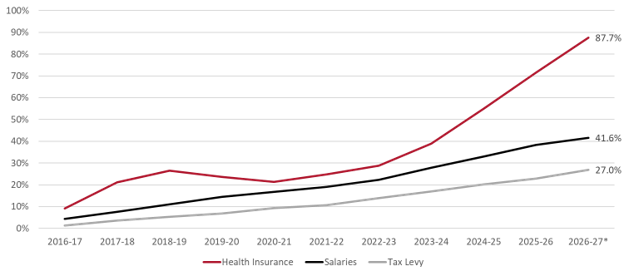
For example, healthcare costs have increased 10.8% over the past year far surpassing any increases in revenue from the tax levy. If a district sets its levy below the cap, its future limits drop permanently, reducing long‑term revenue. Over time, this can lead to program cuts, fewer staff, reduced services or larger tax increases later.
The graph shows how increases in contractually-obligated health insurance and salary costs far outpace increases in the tax levy.
Figure 1: Cumulative increase since 2015-2016.
State aid. Although the district expects to receive a modest increase in Foundation Aid this year, the rise in operating costs continues to far exceed the growth in state funding. Increases in cost drivers, such as those discussed below, are outpacing the incremental boost in aid. As a result, even with additional state support, the district faces a widening gap between revenues and the actual cost of maintaining current programs and services.
Cost drivers. Several factors driving the year‑over‑year budget increase are outside the district’s control. These include state‑mandated special education services, contracted transportation costs stemming from the ongoing bus driver shortage, rising utility expenses and higher employee benefit and health insurance costs.
Health insurance expenses alone are projected to increase by $2.4 million (10.8%). This jump is largely due to escalating prescription drug prices, particularly high‑cost specialty medications. These increases mirror national trends showing double‑digit growth in prescription drug spending and rising overall medical costs, including greater hospital utilization and higher‑intensity care. As a result, this significant surge in health insurance costs consumes most of the new revenue permitted under the tax levy cap.
Additionally, the district must fund both special education and transportation services without receiving extra state or federal support. Because of the bus driver shortage, GCSD has been required to rely on contracted transportation, which further increases transportation costs.
Capital debt. The increase in capital debt expense for this year is primarily due to the implementation of the 2025 capital project approved by voters in 2025. Approximately $560,000 in new capital debt has been added as we begin paying the initial expenses associated with that project. This funding was already approved by voters, and as a result, it is legally restricted for the capital project only. These funds cannot be redirected or used for any other purpose.
Recommendations
The 2026-27 draft budget recommends adjustments that align our staffing and programs with current enrollment, state requirements and financial realities. The plan includes targeted reductions, program restructuring and select investments to protect essential student services while keeping the district fiscally responsible.
Key changes focus on right‑sizing staff across all grade levels, eliminating certain co‑curricular activities and investing in areas where services are required by law or needed for student learning—such as English as a new language (ENL) support, special education needs and key academic programs.
Following is a breakdown of budget reductions by school level:
Elementary Level
- Reduction of proposed fifth-grade sections at Lynnwood and Pine Bush (class sizes will remain at 2025-26 levels)
- Additional reductions in art and reading instruction
- Elimination of first-grade teaching assistants
- Elimination of the Positivity Project and enrichment supplies budget
- Reduction in tech liaisons in non-Title I schools from two to one per building
- Addition of ENL instruction to meet mandated English language learner service hours
Middle School Level
- Reductions in enrichment offerings
- Elimination of co-taught Spanish and Studio in Art
- Addition of sixth-grade world language section
- Provision of double-accelerated math
- Elimination of a TV studio position
- Reductions to co-curricular stipends, with several clubs discontinued
High School
- Elimination of science teacher (through attrition) and library clerical position
- Reduction of instructional time in social studies, art, PE and music
- Reduction in the number of math teaching assistants from two to one
- Reductions to co-curricular stipends, with several clubs discontinued
- Continuation of online access to AP registration and exam fees
- Provision of required AP business and finance teacher training
- Investment in Yondr pouches for incoming ninth-graders
Athletics
- Elimination of several modified and freshman teams, including Mod 9 soccer, Mod 9 girls basketball, freshman football, freshman boys basketball and freshman baseball
- Windscreen replacement for tennis courts
- Coverage of increased officials’ fees
Special Education
- Creation of a third Comprehensive Skills Program class at FMS
- Elimination of one special education teacher through attrition
- Elimination of five special education teaching assistant positions
- Increase in BOCES and out-of-district tuition based on mandated student placements
District-Wide Adjustments
- Elimination of a utility worker position and director of diversity, equity and inclusion
- Creation of a director of special programs to oversee UPK, CSP and MTSS (this position is partially funded by a grant)
- Reductions to instructional technology materials and services
Next steps
A Q&A session will be held at 7 p.m. March 17 in the GHS LGI to give community members an opportunity to learn about the 2026-27 draft budget, ask questions and share feedback. This informal conversation is designed to provide residents with clear information about budget priorities, spending and the impact on students and taxpayers. All families and community members are encouraged to join this discussion.
Important upcoming dates
March 31: Board of Education Budget Work Session
April 14: Board Action to Adopt the Proposed Budget
May 5: Budget Hearing
May 19: Budget Vote and Board of Education Election
For a recap of this information, please visit the GHS Media page to view the March 10 Board of Education meeting.