
Success at Guilderland High School looks different for every student. Some students excel academically, while others find their passion through music, art or athletics. For others, it begins in a technology classroom, workshop or Career and Technical Education program where learning comes to life through hands-on experiences.
As educators across New York discuss graduation pathways that recognize students’ diverse strengths and aspirations, Guilderland’s technology and engineering programs already reflect that philosophy by helping students explore interests, develop skills and prepare for a variety of futures.
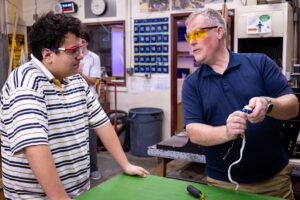
Walk into one of the school’s technology classrooms and the evidence is everywhere. Shelves and workbenches are filled with student creations: ping pong ball launchers, model homes designed in a variety of architectural styles, moving toys powered by simple machines and other projects built with tools of the trade.
Students work alongside their teachers to master tools, practice safe techniques and design solutions to real-world problems. Hanging on the doorway is a worn sign that captures the spirit of the program: “Everybody isn’t a lawyer or doctor. Teach kids it’s OK to work with your hands and build cool things.”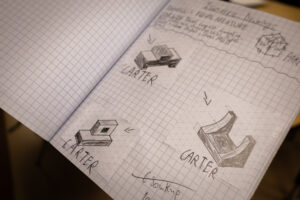
For senior Jayden Walsh-Knoetgen, discovering those opportunities started as a freshman.
“I love technology and stuff. I love working hands on,” Jayden said. “Everything we do is hands on. It helps me learn better, and I can actually understand things when I’m working hands on.”
What began with design, drawing and robotics courses evolved into a clear vision for the future. Today, Jayden attends a Capital Region BOCES Career and Technical Education (CTE) engineering program and takes college-level mechanical engineering courses through Hudson Valley Community College, where he works with technologies ranging from robotics and CAD to wiring and manufacturing systems.
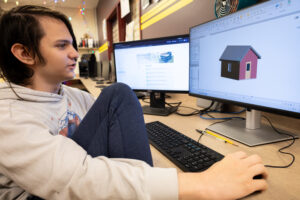
His experiences have also introduced him to emerging industries shaping New York’s economy. Through his CTE program, Jayden visits NY Creates, where students learn about semiconductor manufacturing, microchips and other cutting-edge technologies.
“After high school, if I get accepted into it, I could go there,” he said of Rochester Institute of Technology. “Right now I’m in Hudson Valley for mechanical engineering.”
Educators say technology education provides an important avenue for students who may learn differently than they do in traditional classroom settings.
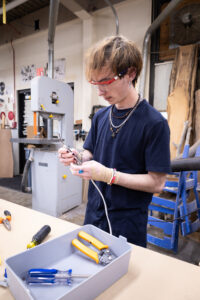
“These classes teach creative thinking, problem solving and engineering,” said technology teacher Max Corbett. “There are tremendous opportunities in electrical, chemical, mechanical and civil engineering.”
Beyond engineering, the courses help students develop practical skills while introducing them to high-demand career fields.
“We teach electricity and manufacturing, which teaches hands-on skills,” Corbett said. “It teaches you how to work with your hands, how to solve problems, how to use machinery and tools, and how to be safe.”
Technology teacher Jim Van Horne said those experiences are becoming increasingly valuable.
“Right now there is a big shortage of skilled labor in this country,” Van Horne said. “There are companies that literally pay people thousands of dollars to go work for them.”
Van Horne said the lessons extend beyond career preparation.
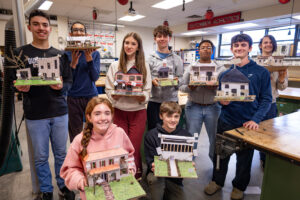
“Students are exposed to hands-on activities where they learn about tools and machines and things like that,” Van Horne said. “It’s kind of like lifelong skills that you take with you anywhere.”
Over the years, Van Horne has seen students discover confidence and purpose through technology education. He points to former student Jack McManus, who found direction through the program before continuing into Career and Technical Education.
“I think he was kind of having a tough time with what he wanted to do in high school,” Van Horne said. “This seemed to be a really good fit for him.”
Other graduates have gone on to careers as service technicians, electricians, engineers and project managers. Some entered the workforce directly; others pursued higher education at schools such as SUNY Polytechnic Institute, Hudson Valley Community College and Rochester Institute of Technology.
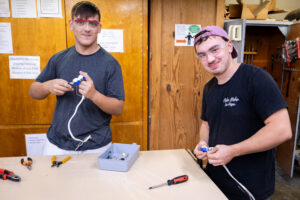
Their paths may look different, but each started with an opportunity to explore an interest and develop skills in a supportive environment.
Senior Quinn Ryan discovered his interest later than many of his classmates.
“I’m going into HVCC for the electrical program,” Ryan said.
Although he discovered his interest in the trades too late to enroll in the BOCES CTE program, he took technology courses to build foundational skills before starting the college program.
“I was just thinking I should at least get a little bit of bare-bones experience before I go in there,” he said.

His experience illustrates an important reality: students do not all discover their interests on the same timeline.
That philosophy aligns with a growing movement in education that recognizes success after high school can take many forms. For some students, the next step may be a four-year engineering degree. For others, it may be a technical certification, apprenticeship, community college program or direct entry into the workforce.
As Jayden prepares for graduation, he knows the opportunities he found through technology education helped shape his future. More importantly, they helped him find a path that matched his interests, strengths and goals.
For educators, that is the ultimate measure of success: ensuring every student has the opportunity to find where they belong and where they’re headed next.