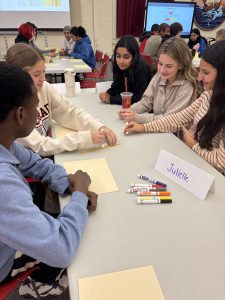
The GHS Student Voices committee is working to refocus on what diversity, equity and inclusion mean within their school community. For these students, this work is rooted in celebrating differences, fostering understanding and ensuring every student feels seen, supported and engaged.
As part of the Student Voice committee’s annual breakfast, the group centered its discussion on equity: what it is, what it isn’t and why it matters. The conversation was shaped by keynote speaker Tibisay Hernandez, Ph.D., who encouraged students to think beyond fairness alone and consider how cultivating a positive, inclusive culture can strengthen connections and support every learner. Her message grounded the morning’s activities in the importance of belonging, empathy and intentional action within the school community.
Examining identity and blind spots
Before turning to the hands‑on challenge, Dr. Hernandez invited students to reflect inward through a social identity wheel activity. Students were asked to identify how they see themselves across various categories, and then consider which identities they think about most—and which they rarely think about at all.
“What seems like a simple exercise,” Dr. Hernandez explained, “can feel very different once students sit with it. The identities people think about the least are often the ones where they hold the most privilege, and the most blind spots. Not because of individual intent, but because systems are designed to make some identities invisible and others hypervisible.”
Dr. Hernandez’s goal was to help students understand that identities don’t cancel each other out. When a student can look at their wheel and honestly say, “I never think about this one,” that moment is worth pausing on. Those unnoticed identities often shape what feels “normal,” who receives the benefit of the doubt and where unexamined limits to compassion can exist. That’s where learning begins.
Understanding equity through a hands-on challenge
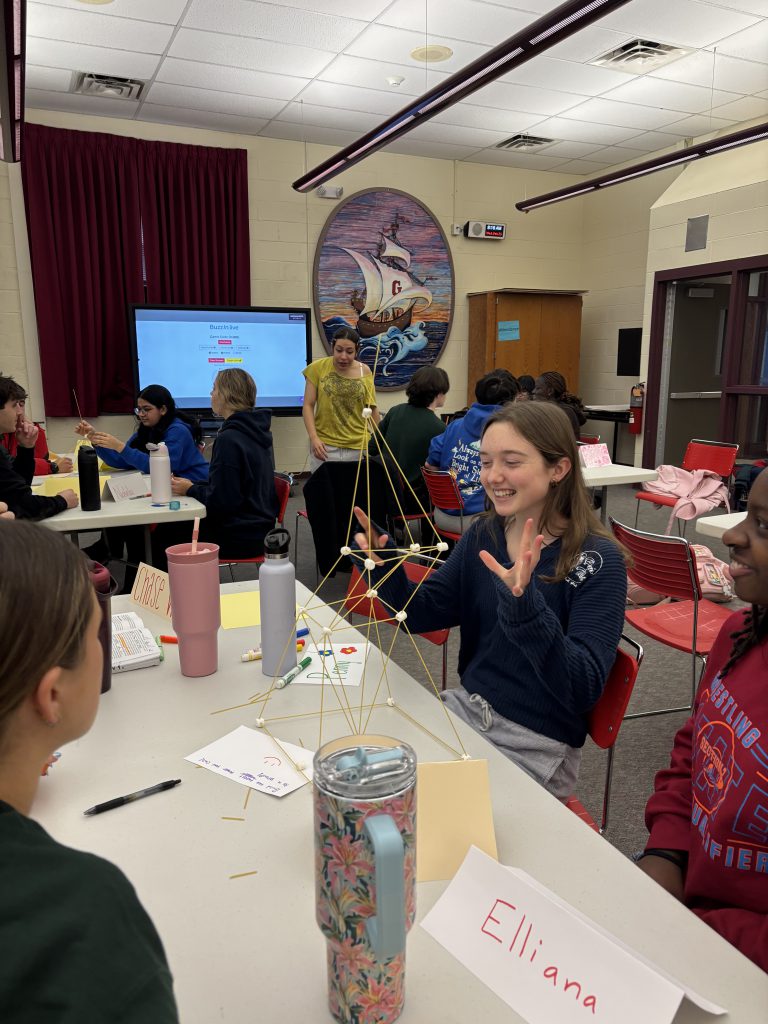
Equitable access to resources and support systems helps ensure that everyone has the tools, spaces and opportunities needed to thrive. To illustrate this idea, Student Voices led an unexpected activity: the marshmallow and spaghetti challenge.
In this popular STEAM challenge, groups attempt to build the tallest freestanding tower using only spaghetti and marshmallows. But this version introduced a twist—the teams didn’t start with the same amount of materials.
“That was the point,” student Kevin Roddy explained. “Not everyone starts with the same things.”
Some groups were given more than enough supplies; others were given less. The imbalance quickly revealed a core lesson: equality and equity are not the same. Teams with plentiful materials built tall towers with ease, while those with limited resources struggled to compete.
Participants who received extra materials acknowledged that they hadn’t considered whether others might be lacking. “When you have a lot,” Kevin reflected, “you don’t stop to think about who doesn’t.”
The activity also uncovered how quickly assumptions can form. “I found myself thinking some groups weren’t very good at the activity,’” said student Ava Volforte. “But in reality, they just didn’t have enough to work with.” Without context, students realized, it’s easy for stereotypes to take root.
Scarcity also shaped behavior: some students attempted to “borrow” from other groups, an example of how inequity can create pressure, competition and tough choices long before actual abilities come into play.
Building connections beyond the event
This year’s theme resonated deeply with participants, who said the face‑to‑face conversations helped break down assumptions and build new relationships.
“[The breakfast] brought together people who are usually separated by schedule or classes,” Kevin shared. “You don’t realize how many people you never get the chance to meet.”
Students recognized that building bridges sometimes means stepping outside your comfort zone. Several suggested incorporating mixed seating next year to encourage conversations among students who don’t typically interact.
“I think getting to know people you wouldn’t normally sit with, asking questions, learning about them, could really strengthen our community,” Ava said.
Together, the social identity wheel and the marshmallow and spaghetti challenge gave students a meaningful way to examine equity, from internal reflection to real‑world systems and outcomes. By recognizing their own assumptions and blind spots, students developed a clearer understanding of what true equity requires: awareness, empathy and intentional action.
As Student Voices continues its work, the goal is for these lessons to shape everyday interactions and further help build a school community where every student feels supported, valued and empowered to succeed.