
What does it take to build a home, prepare food, make tools or stay warm when everything you need must come from the natural world around you?
Those are some of the questions fourth graders explored during Longhouse Week, a Lynnwood tradition that has continued for nearly 30 years. The immersive study of Haudenosaunee history and culture combines classroom lessons, hands-on activities and collaborative projects designed to help students better understand the people, traditions and ways of life that have shaped this region for generations.
Throughout the week, students transformed what they learned in the classroom into a model Haudenosaunee village, complete with a longhouse, stockade, corn garden, Tree of Peace, cookfire, drying rack and clan signs they researched as part of the unit. They then became the teachers themselves, welcoming fellow students and guests and leading tours of their work.
The experience encouraged students to do more than memorize names, dates and facts. Teachers challenged them to think about how Haudenosaunee people used the resources around them to meet everyday needs and solve problems.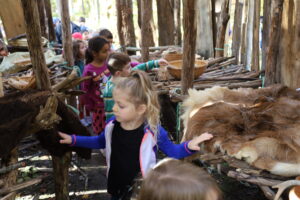
Throughout the week, students rotated among the fourth-grade classrooms, where teachers created activities highlighting different aspects of Haudenosaunee life and culture.
In Joe Sorriento’s classroom, students explored transportation and learned how Haudenosaunee people used natural resources such as birchbark to create canoes for fishing and travel. In Kristen Janssen’s classroom, students worked with clay to make pottery similar to vessels traditionally used for cooking and food storage.
In Nicole Cioffi’s classroom, students learned about the Haudenosaunee language and the role of wampum belts in preserving important stories, agreements and historical events. Because the Haudenosaunee traditionally passed knowledge through oral history rather than a written language, wampum belts featuring carefully arranged shell patterns helped record and remember significant events. Students also read a Haudenosaunee legend and created corn husk dolls using methods and materials similar to those used by Haudenosaunee children.
Beyond the classroom, students participated in archery during physical education, learning about a skill historically used for both hunting and sport. Before and during Longhouse Week, the fourth-grade team read If You Lived With the Iroquois with students to help build background knowledge about daily life, traditions and community before bringing those lessons to life through hands-on experiences.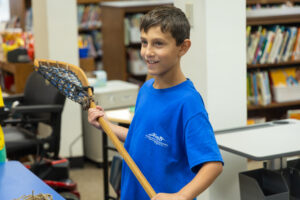
Students further enriched their learning during a visit from retired museum professional and consultant Colette Lemmon. Lemmon brought artifacts and replicas that students could examine as they learned how natural materials were used for everything from tools and pottery to games, musical instruments and shelter.
Students experimented with grinding corn, using traditional tools and learning how friction could be used to start a fire. Along the way, many expressed amazement at the knowledge and resourcefulness required to create what was needed from the materials available.
“I want to learn how they had to live,” one student said when asked why studying Haudenosaunee culture was important.
Another focused on what the experience revealed about everyday life: “We learn how they survived and what they did to keep them alive.”
Understanding a history that is also our history
Longhouse Week gives students an opportunity to better understand the people who called this region home long before European settlement.
Haudenosaunee history is woven into the history of New York state. But Lemmon stressed that students should not come away thinking of Haudenosaunee people only in the past tense.
“Their cultures are still very present here today,” she said. “Their story of endurance and resilience is something to be admired and respected.”
That distinction matters. Haudenosaunee nations remain sovereign today with their own systems of government and longstanding treaty relationships with the United States.
Students also learned about the Haudenosaunee Confederacy and its Great Law of Peace. The Confederacy united the Mohawk, Oneida, Onondaga, Cayuga and Seneca nations, with the Tuscarora joining later. Its system of governance has been recognized as an influence on the development of democratic principles in the United States.
Lemmon also encouraged students to recognize the sophistication behind a way of life deeply connected to the natural world. It required a deep understanding of science, mathematics, plants, agriculture and the properties of natural materials, with knowledge accumulated and passed from generation to generation.
“It wasn’t book knowledge,” Lemmon said.
Learning about others, learning about ourselves
The lessons of Longhouse Week extend beyond one period in history.
For teachers Joe Sorriento, Kristen Janssen and Nicole Cioffi, the goal is to help students develop an accurate and respectful understanding of the Haudenosaunee as living Indigenous people, recognize their significant contributions to history and society, and reflect on how community, cooperation and relationships with the land shape the way people live.
Learning about cultures and experiences different from our own can help students develop empathy, challenge assumptions and see the world from new perspectives, preparing them to learn, live and work alongside people from many different backgrounds.
Longhouse Week makes those ideas tangible for fourth graders. Students aren’t simply told to appreciate another culture. They ask questions. They handle objects. They try unfamiliar tasks. They work together. And ultimately, they share their newfound knowledge with others.
For Lemmon, there is another lesson embedded in that experience. Haudenosaunee society placed a strong emphasis on connection and collective responsibility.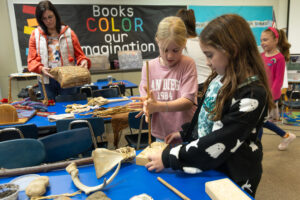
“Almost everything we were doing during my visit we were doing as a group, collaboratively,” Lemmon said. “It was really about community, and it still is today.”
For the Lynnwood fourth-grade team, that sense of community is one reason Longhouse Week has remained a beloved tradition for nearly three decades.
“This hands-on experience is something that fourth graders look forward to and something they’ll never forget,” the teachers said.
By building, exploring and learning together, students discovered that understanding history is also about understanding the communities that connect us today.